
Let’s get this out of the way: Charlie’s Angels and Ace Venture: Pet Detective (next week’s Recommendation) have aged about as well as a forgotten pot of yoghurt at the back of your fridge. One is a transphobic slapstick farce starring a human cartoon character; the other is a hyper-sexualised, male-gazey explosion of flip kicks, latex, and wire-fu camp masquerading as girl power. In today’s post-woke cultural landscape, both films are easy targets for criticism and for good reason.

Take Ace Ventura first. Released in 1994, it’s pure unfiltered Jim Carrey at his most elastic, anarchic, and unhinged. It’s also a film whose final twist hinges on humiliating a trans woman, with the climactic gag being the revelation of her anatomy as dozens of men gag in horror. In 2025, it’s an undeniably cruel punchline that punches down rather than up, wrapped in a script that has all the social sensitivity of a coked-up stand-up comedian in a smoky 80s nightclub. The humour is so broad it borders on offensive parody, and yet… we still watch it.
Why? Because Ace Ventura is also a time capsule. It represents a comedic era before the internet scrutinised every punchline, before #CancelCulture trended, before we collectively decided that comedy must never offend. There is something undeniably liberating about watching Carrey contort his face like a malfunctioning Muppet, wrestle with a great white shark and emerge the winner, and scream “Alrighty then!” at terrified civilians with no sense of irony. It’s stupid, childish, and problematic and therein lies its chaotic charm.

Then there’s Charlie’s Angels (2000). On paper, it’s an empowering female-led action movie. In practice, it’s a 90-minute music video designed to sell thongs and sunglasses to teenagers. Cameron Diaz, Drew Barrymore, and Lucy Liu bounce through scene after scene in skimpy disguises, tight leather, and slow-motion hair flips, while Crispin Glover sniffs their locks like a feral raccoon. Empowering? Maybe, if you squint through the lens of ironic nostalgia. Objectifying? Absolutely. But is it fun? Hell yes.
Because Charlie’s Angels doesn’t care about your social critique. It was made in the era of TRL and Maxim magazine, when feminism was repackaged as marketable girl power aesthetics, and Hollywood’s idea of empowerment was letting women kick ass as long as they looked hot doing it. It’s problematic in its framing, shallow in its messaging, and yet radiates such campy joy it’s impossible to completely hate. Diaz’s dorky dancing, Barrymore’s rebellious warmth, Liu’s deadpan domination, they’re all in on the joke, and we are too.
The question isn’t whether these films hold up morally, they don’t. It’s whether we can watch them now with self-awareness, acknowledging their flaws while still finding value in their humour, energy, or nostalgia. Cultural critique is vital, but so is historical context. Ace Ventura and Charlie’s Angels are products of a pre-woke, pre-social media world where comedic cruelty and objectifying camera angles were normalised to the point of invisibility. That doesn’t excuse them; it just explains them.
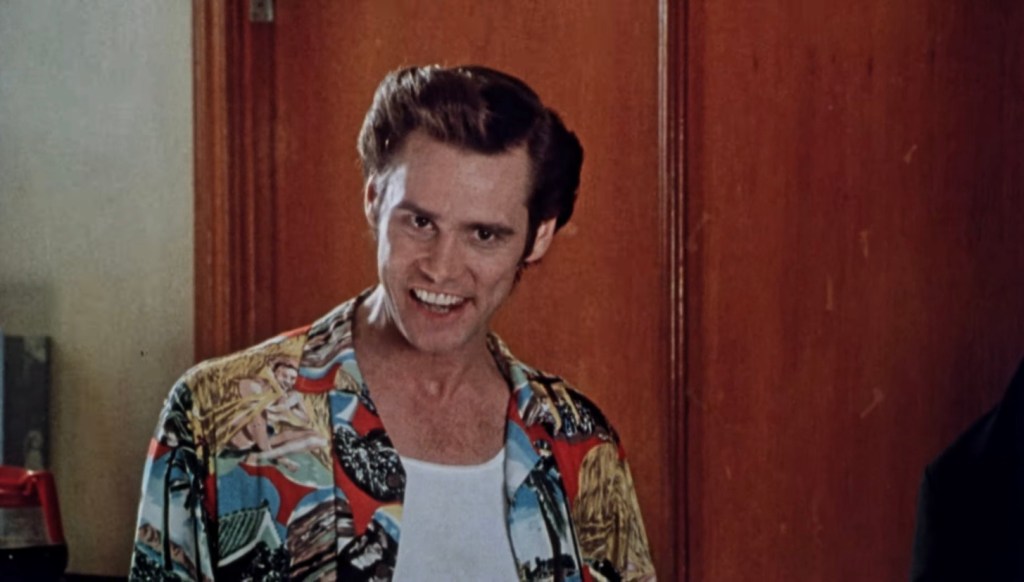
But here’s the secret no one wants to admit, sometimes we just want to switch off our moral radar and just feel something unfiltered. Watching Carrey talk out of his backside is dumb and offensive, but also strangely cathartic in its anarchic nihilism. Seeing three women take down a room full of goons in slow motion, framed like a Victoria’s Secret ad, is exploitative but it’s also fun in the same way old Spice Girls videos were fun: bright, brash, and unapologetically shallow.
Does that make us bad people? No. It makes us human, capable of enjoying problematic art while still critiquing its failures. Capable of laughing at immature jokes while recognising their harm. Capable of holding multiple truths at once without deleting history for moral cleanliness.
So yes, Ace Ventura is transphobic. Yes, Charlie’s Angels is a feminist paradox wrapped in glossy male fantasy. But they’re also relics of a time when comedy and camp didn’t care about approval ratings or moral rankings. They just wanted to entertain, to shock, to titillate, and to make you laugh out loud and on that front, they succeeded. In a world where we endlessly police taste, it’s worth remembering that guilty pleasures are meant to be just that: guilty. Cringe-inducing. Questionable. Messy. Bu if you can hold that guilt alongside your laughter, maybe you’ve matured more than these films ever did.
(Images owned by and courtesy of Youtube)

 The Screen Scribe
Leave a comment