When Mobile Suit Gundam 00 premiered in 2007, it looked like allegory. Three power blocs, energy monopolies, terrorism, and a private army swooping down from orbit to “end war through war.” At the time, critics called it heavy-handed. A Gundam for the War on Terror generation. But in 2025, 00 doesn’t read as allegory. It reads as prophecy.
The Earth of 2307 is our world in disguise. Multipolar, unstable, riven by energy politics, insurgency, and populist leaders clawing at the wreckage of global institutions. We don’t have Gundam’s descending from the heavens, but we have Trump’s nativist bombast, Putin’s revanchism, Gaza’s endless spiral of blood and reprisal, China’s strategic patience, and Europe’s slow fracture under the weight of crises.
If you want to understand today’s geopolitics, you don’t need Kissinger. You need Gundam.
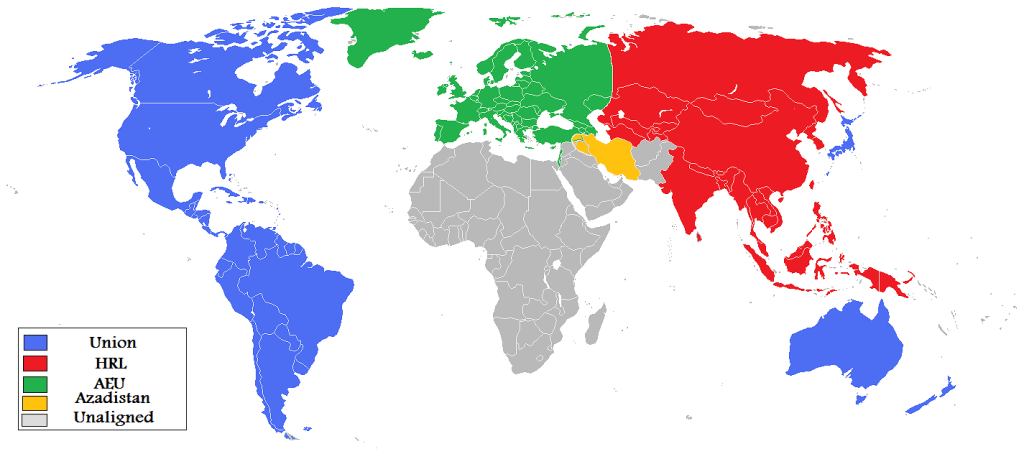
Gundam 00 split Earth into three blocs: the Union (the U.S. and its allies), the Human Reform League (China and Russia in lockstep), and the AEU (a brittle Europe stumbling along behind). In 2007, this was speculative. In 2025, it’s the news ticker.
The Union was defined by arrogance, military dominance masking domestic rot. That’s Trump’s America in a nutshell, a superpower obsessed with strength but hollowed out by division, isolationism, and the cult of personality. Trump’s “Make America Great Again” policy is not far removed from the Union’s swagger, short-term dominance, long-term decline.
The HRL was pragmatic authoritarianism, Russia and China combining muscle and numbers to balance against the West. That’s Putin today, waging imperial war in Ukraine while leaning on Beijing to secure his survival. A new authoritarian bloc, opportunistic and ruthless.
And the AEU? Anxious, divided, endlessly bureaucratic. That’s Europe in 2025. Struggling with migration, energy crises, and NATO’s future while still pretending to project unity while remaining toothless in the face of adversity. When Gundam 00 presented this tripolar map, it looked like sci-fi. Today it looks like the G7 and BRICS arguing at the UN while bombs fall in Gaza.
The conceit of Celestial Being was radical in 2007. A private army imposing peace by force. At the time, it felt like idealistic nonsense. But then came the Blackwater massacre scandal in 2007. Then Wagner, the Russian private military company. The creation of drones, further founding of PMCs, militias and cyber-armies. Today, the monopoly of violence has slipped. States no longer hold it exclusively. Private actors fight wars for profit, ideology, or sheer chaos. Yevgeny Prigozhin’s Wagner wasn’t a Gundam squad, but the principle was the same, ideology and violence without accountability.
Then there’s drone warfare, surgical strikes justified as “peacekeeping interventions.” Obama normalized them, Trump escalated them, Biden maintained them. The rules and regulations have fluctuated depending on who is sitting in the White House. It’s Celestial Being without the Gundam’s, without the noble intentions, just algorithms and contractors. Gundam 00 dared to ask who has the right to intervene in conflict? In 2025, that’s not a philosophical question. It’s every headline about Gaza, Ukraine, or Yemen.

In 00, the great power blocs monopolized solar energy via orbital elevators. It was a metaphor for oil, but it reads better now as a metaphor for everything. Fossil fuels, renewables, rare earths, semiconductors. Europe’s reliance on Russian gas plummeted after 2022, when Putin turned off the taps. China currently controls vast rare earth supplies and solar panel production, holding the keys to green energy transition. The Middle East, Gaza included, sits atop contested natural gas reserves. Even the U.S., supposedly energy independent, finds its global leverage tied to fracking and OPEC negotiations.
Energy dependency is still the axis on which geopolitics spins. Gundam 00 didn’t just predict the fight for oil. It predicted the fight for everything. Where Gundam 00 was ahead of its time was in refusing to portray terrorism as faceless evil. It showed insurgency as the consequence of inequality, resource starvation, and systemic abandonment. That’s why it resonates so bitterly today.
Look at Gaza. Look at asymmetric warfare across the Middle East. Gundam 00’s logic holds, that terrorism is born in power vacuums, in communities stripped of dignity, trapped between superpower proxy wars. Western media still prefers black-and-white narratives, but Gundam 00 didn’t. It made you look at the humanity beneath the insurgent’s mask. It showed terrorism as the language of the voiceless, not just the act of monsters. That doesn’t excuse it. Neither did Gundam. But it explained it, and explanation is the first step toward understanding, something global politics still resists, or rather, fails to comprehend.
When Gundam 00 aired, the U.S. was still hegemon. Multipolarity was theory, but now it’s fact. Trump has shattered American credibility abroad across both his terms in office, ceding ground to China and Russia. Putin’s wars make clear that authoritarian powers feel emboldened to redraw borders by force. China has spent the last decade using its Belt and Road Initiative to finance and build ports, railways, and digital networks abroad, creating trade routes and economic dependencies that extend its influence far beyond East Asia. While Europe dithers and the UN continues to lose public credibility and authority in the face of multiple warfronts.
The three blocs of Gundam 00 are here, not in orbit, but on Earth. They’re called Washington, Moscow-Beijing, and Brussels, and like the anime, they fight proxy wars while the global south bears the brunt.

In 2007, fans dismissed Gundam 00 as too on-the-nose. Heavy-handed politics in a franchise already famous for political allegory. But time has vindicated it. 00 wasn’t melodrama, it was diagnosis. It showed us private militaries before Wagner. It showed us energy monopolies as Nord Stream-style politics hardened. It showed us multipolar blocs before BRICS. It showed us insurgency born of inequality before the Arab Spring, before ISIS, before Gaza 2023.
In a genre too often reduced to “giant robots hit each other,” Gundam 00 proved mecha can be prophecy. Gundam 00 isn’t escapism, it’s indictment. It’s the anime that told us where the world was going while we dismissed it as melodrama. In 2007, it was speculative fiction. In 2025, it’s an animated documentary with sci-fi trappings. Because the truth is brutal, we don’t have Gundam’s descending from orbit to impose peace.
Instead, we have Trumpists chanting nationalism, Putin shelling cities, Israel and Hamas locked in endless blood, and a planet strangled by energy dependency. When you look at Gundam 00 through the lens of today, you realize it wasn’t warning us about the 24th century. It was giving us a tactical forecast about the present.
(All images and videos are owned by and courtesy of Youtube)

 The Screen Scribe
Leave a comment