When it comes to military films, some aim for spectacle, others for grit. Tears of the Sun, directed by Antoine Fuqua and released in 2003, falls firmly into the latter camp. It’s not the loudest war film, nor the most decorated, but it is one of the most emotionally charged explorations of duty and sacrifice in modern action cinema. Led by Bruce Willis in one of his most restrained performances, the film reminds us that behind every mission briefing and tactical manoeuvre lies the brutal weight of moral choice.
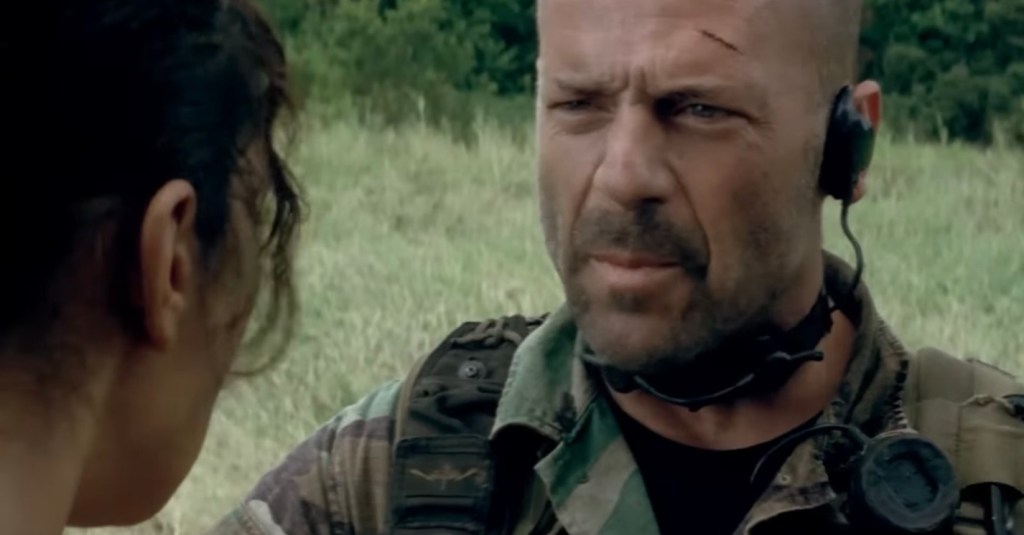
The story is set against the backdrop of political turmoil in Nigeria, where a violent coup has left the country in chaos. Lieutenant A.K. Waters (Willis) and his team of Navy SEALs are sent on a straightforward mission: extract Dr. Lena Kendricks (Monica Bellucci), a doctor working in a remote mission, and bring her safely out of the conflict zone. But Dr. Kendricks refuses to abandon the villagers under her care, and Waters finds himself forced to choose between following orders or following his conscience. What begins as a simple extraction turns into a harrowing journey through the jungle as the SEALs escort refugees to safety while pursued by hostile forces.

What makes Tears of the Sun stand out is its refusal to sugarcoat the realities of such a mission. The violence is unflinching, the pace deliberate, and the weight of command heavy on every decision Waters makes. Willis strips away the wisecracking bravado audiences knew him for in Die Hard, instead delivering a performance defined by weariness, quiet authority, and moral conflict. His Waters is not a gung-ho action hero, but a soldier torn between orders and empathy.
The supporting cast adds to the authenticity, with Fuqua assembling a believable SEAL team played by actors like Cole Hauser, Eamonn Walker, and Johnny Messner. Their camaraderie feels natural, their discipline convincing, and their sacrifices hit hard. Bellucci, meanwhile, plays Kendricks with a mix of compassion and steel, serving as the moral compass of the film.
Fuqua’s direction leans heavily into atmosphere. The cinematography captures the oppressive heat and danger of the African jungle, while the action sequences, when they erupt, are raw and brutal rather than glossy. The ambushes, firefights, and desperate escapes are staged with clarity but without glamour, grounding the film firmly in realism. Hans Zimmer’s haunting score deepens the emotional pull, blending mournful chants with stirring orchestration to underline the film’s themes of loss and resilience.
Beyond the action, Tears of the Sun is ultimately about responsibility. The film asks difficult questions: What does it mean to serve? When do orders stop being enough? How much should one man sacrifice for strangers? These aren’t questions with easy answers, and Fuqua doesn’t pretend they are. Instead, he leaves the audience with the sobering reminder that real heroism often comes at a terrible price.

While critics at the time were divided, Tears of the Sun has endured as a respected entry in the military film canon. It may not have the scale of Saving Private Ryan or the political sweep of Black Hawk Down, but it resonates because of its focus on character, conscience, and the quiet costs of war. As the second entry in our Military Month collection, Tears of the Sun is a serious, sobering, and deeply human film that doesn’t glorify conflict but instead honours the burden carried by those who must make impossible choices in the fog of war.
(All images and videos are owned by and courtesy of Youtube)

 The Screen Scribe
Leave a comment